
Emergency Dial : 911

The history of the Chambersburg Fire Department was written by the firefighters over the past 243 years.
It was recorded by the following members:
It was chronicled by the following news sources:
It is kept alive in the memories of the following members who shared stories and timelines:
Alan Witter Larry Miley Jeff Umberger Randy Himes
Chris Brown Kevin Henry Terry Shaffer
It was compiled by Jackie Umberger, 2023
The history of the Chambersburg Fire Department is woven within the history of Chambersburg the town, and one reveals much about the other. Both Town and Fire Department are old, at least by American standards. Both have experienced good times and bad, and both have grown and ebbed. Both are comprised of the citizens who care about family and community. Ultimately, both still exist to provide a better life for the citizens of our community.
Part I: Birth and Growth
Chambersburg was born in 1730 when Benjamin Chambers established a grist and saw mill at the confluence of the Falling Spring and Conococheague Creeks. The area was still considered wilderness, with all the associated concerns, including Native Americans who were not thrilled with the invasion of their land. Despite the dangers, settlers started to arrive. By 1744, the Great Wagon Road, connecting Philadelphia with the Shenandoah Valley was completed, running through the southeastern corner of Franklin County on its way to Martinsburg, Charlotte, and Knoxville. The French and Indian War negatively impacted population, even though Benjamin Chambers built a fort for protection. Settlers did not start to return until the peace treaty between Great Britain and France was signed in 1764.
The town was laid out at that time, and lots were advertised for sale on July 19, 1764. Local troops were raised to fight the War of Independence, including Benjamin Chambers sons. By 1784 a local militia was formed, with Benjamin Chambers named as Colonel. The town grew significantly in this period.
The first fire department in the colonies was established in Boston, MA in 1678. This was a paid fire department. Benjamin Franklin started the first volunteer fire company in the colonies in 1736, in Philadelphia. The first Chambersburg fire company was organized March 31, 1780, as the United Fire Company. Some records indicate that it was the second volunteer fire company in Pennsylvania, however definitive proof of this has not yet been found by the author.
The United Fire Co. was a “bucket and bag” operation until circa 1800: Its members carried large bags, used to remove possessions from a burning building, and used leather buckets to form bucket brigades to try to stop the fire from spreading. They got a hand carried* engine in the early 1800’s, and in 1820 bought a green gallery suction engine**. An article from the Public Opinion of Oct. 8, 1962 states that they got the first suction engine in 1846. In 1855 they purchased a new engine from Mr. Agnew of Philadelphia for $950.00. Around the same time, the hand drawn hose reel known as the White Swan was purchased. The early engines, such as the hand carried engine, would need men to pump, and men to form the bucket brigade that would fill the well with water. The suction engine was actually able to draw water in from a source, eliminating the bucket brigade. It still, however, required men to pump. The 1855 engine made by Mr. Agnew of Philadelphia was known as the “Little Red Suction Engine”, and was hand drawn. It was used by the Friendships until 1869, and by the Juniors from 1872 until 1882, when it was sold to McConnellsburg, where it remained in service until the water system was installed circa 1900. The fire company was housed in Friendship Hall, adjacent to the Market House as of 1830. (Now the Chambersburg Police Department.) M. L. Marotte, citing Borough Council Minutes, states that they had more than one house prior to “Friendship Hall”, one in an unknown location, and the second on Main St. (The site of Long’s Jewelers in 1980.) They remained at Friendship Hall until 1911, when they moved to their house at East Point (intersection of Lincoln Way and Queen St.)
(*The engine from the early 1800’s is often described as a “Button” engine. Research shows that the Button engine was a brand name from Waterford NY. The owner of the Button Fire Engine Company, Lysander Button, was not born until 1810. The business did not come into being until circa 1832, and it was not called the Button Fire Engine Company until 1834. No earlier references to a button engine, as a type of fire engine, have been located. **No information has been found regarding the green gallery engine – research is ongoing!)
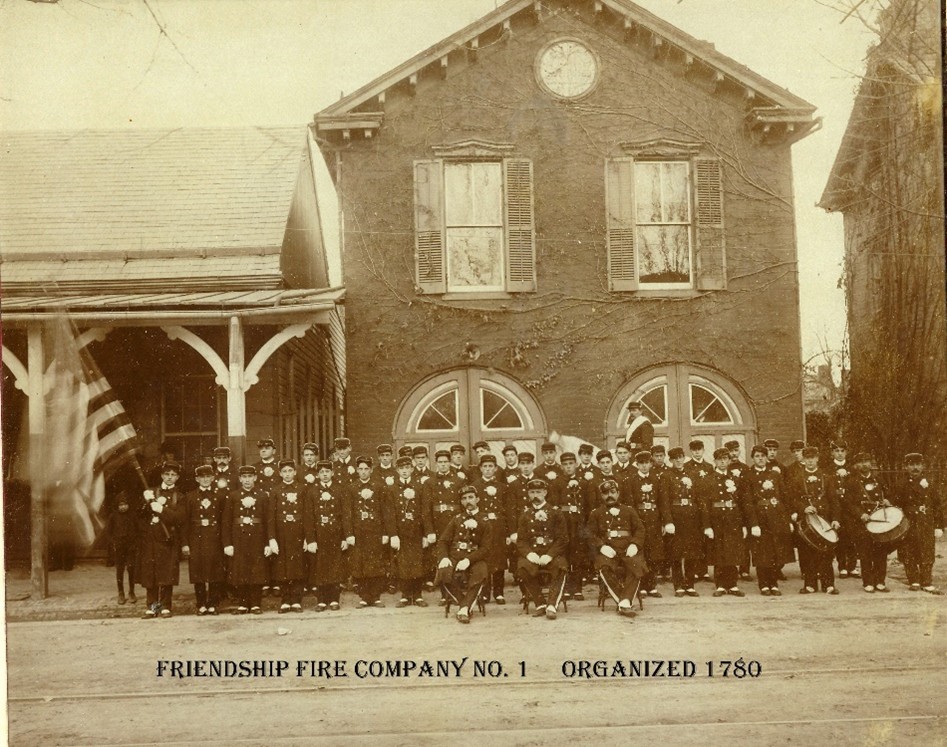
In 1830 there was a fierce debate over the selection of a new name for the United Fire Co. until member P. R. Hazlett extended his hand to member W. Reilly and said, “I extend my hand in friendship to all.” The Friendships were incorporated in 1838. The information is taken from M. L. Marotte’s book “History of the Friendship Fire Company of Chambersburg”, compiled for their 200th anniversary in 1980, and gives no further explanation of why the name was to be changed. Mike Marotte has done an amazingly thorough examination of the records regarding the Friendships, and has not put forth a theory that I am aware of.
The second volunteer company established in Chambersburg was the Hope Hose Company. Their exact origins are unknown as their records were lost to fire during the Burning of Chambersburg in 1864. It is known that they originated circa 1830. Their first engine house was located on East Market St. (now Lincoln Way East) behind the Court House. Phillip Bietsch, in his book Backward Glances, indicates that they may have been organized prior to 1830, possibly before the Friendships. The book “A History of Franklin County, Illustrated, published in 1887, says the Hopes are thought to be the descendant of the first fire company in Chambersburg, and had two names prior to 1830. However, the book also completely omits the CV Hose Co, which had been established 10 years prior to publication. The truth will likely never be known.
In 1840 Chambersburg was divided into 2 wards, with Queen St as the dividing line. The Friendships were located on South Second St. next to the Market House (now Borough Hall), and became known as the Southern Company. The Hopes, on Market St, came to be known as the Northern Company, and changed their name to the Northern Company.
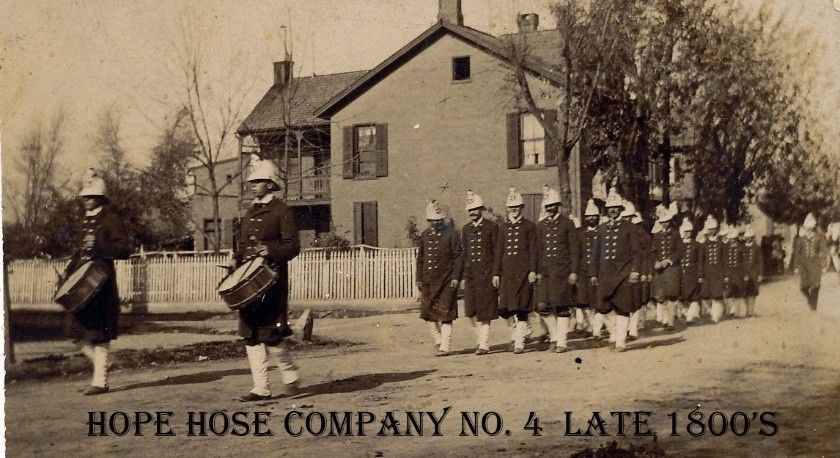
The Hope’s first engine was a hand drawn one, manufactured by the well-known John Agnew of Philadelphia. In 1855 they met with Mr. Agnew to discuss the possibility of a new hand drawn engine. By 1856 they had their new engine, which cost $3000.00*and had voted to change their name back to Hope Hose Co. (*The 3000.00 price tag quoted by one source seems unlikely compared to the $950.00, (reported by the newspaper) price of the new engine purchased by the Friendships the preceding year, from the same maker. However, The Pennsylvania Engine Co. #12 of San Francisco, CA paid $5000.00 for their engine from Mr. Agnew in 1855.)
Meanwhile, in December 1858, some gentlemen convened in Franklin Hall, (later Repository Hall, then Chambersburg Trust, now the new Courthouse), to talk about the need for a hook and ladder company. The Protection Hook and Ladder Company was incorporated April 11, 1859. Borough Council used a part of the eastern wing of the Market House to build a truck house, and gave them meeting space on the second floor. Later they relocated to the old German School building on East Queen St, east of Market House. They paid rent there until 1864, with the truck kept in the arch under the building. After the fire they relocated the truck to the Washabaugh Brewery on Conococheague Ave. near West King St., and met on the 3rd floor of town hall. They bought their first truck on Jan. 12, 1859, with cash and subscriptions. It was 46 feet long, with 5 ladders, 6 fire hooks, 2 picks, and 5 lanterns.
1861, Borough Council appoints a Chief Engineer, Capt. Jeffries, and one Assistant Engineer from each of the three companies – R.M. Perry, Friendship; John King, Hope; Jacob Shaffer, Protection. This is the first reference that I have found to the “Chambersburg Fire Department”, although it will not officially be known by that name until much later.
Part II: Coming of Age
1864 will always be remembered as the year of the Burning of Chambersburg. The Hope’s lost their station and most of their records and possessions during this fire. The Friendships worked to save Brown’s Hotel, now the Public Library (1944), on the northwest corner of South Second St. and East Queen St. They saved everything but the roof. Firemen and citizens worked together to keep the flames from spreading to the Methodist Church (which survived the 1864 fire only to be lost to fire in 1991), the Masonic Hall, and Market House (now City Hall). The hand drawn hose reel known as the White Swan, purchased around 1850, was used in this fire. The White Swan resides today in the Chambersburg Volunteer Firemen’s Museum on Broad St. Many of our volunteer firemen volunteered for the army during the civil war, including future members of the Good Wills, CV’s, and Juniors.
Following the fire, as Chambersburg struggled to rebuild, the Hopes struggled to recover from the loss of their building and possessions. It wasn’t until 1866 that they rallied, due in part to the Borough buying them a secondhand engine and hose carriage. There is no consensus on where they resided at that time, some saying in the eastern end of the Market House, some stating across from the CVRR depot on Third St. However, by 1872, still struggling for membership, they essentially went out of existence. The company was reorganized in 1877 and relocated to the 4th ward. Their station was on New England Hill on West Market St., now Lincoln Way West. In 1888 the Borough built them a house on the southeast corner of Martin Ave. and Franklin St. They remained there until a new station was built in 1903.
In 1871 the Borough purchased the first steam fire engine for the Friendships. They changed their name to the Friendship Steam Fire Engine Co, then later back to the Friendship Fire Co. The steam engine marked a dramatic change in the face of firefighting. Early engines needed to be close to the fire in order to be effective. Even the early steam engines could move water a much further distance, enabling the engine to be placed at a safer distance from the fire, and closer to the water supply. “The engine was of third class, No. 92 and was built by the Amaskeag Manufacturing Company at Manchester, NH. It was first owned by a company in NJ. It was a single plunger pump engine, with a harp tank, and weighed about 4000 pounds. The first fire was a fiasco. A washer fell off the drafting sleeve and of course, it then drew air instead of water. The Friendships learned from their mistake! They procured a pair of horses, and practiced until they could get water on the fire in under 10 minutes. This is the first time that fire apparatus was pulled by horses in Chambersburg.” This information is taken directly from M. L. Marotte’s book. This steamer was used until April of 1891 when the boiler was declared unsafe and the unit was taken out of service. The Borough would be without a steam fire engine until the Good Will unit was placed in service in 1893, although the Good Wills started campaigning for one as soon as the Friendship unit was placed out of service.
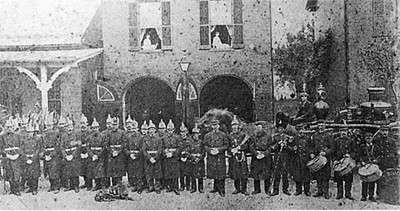
The boys of town would always gather when the Friendships were drilling or having pumping practice at the cistern under the Market House. The need was seen to keep their interest, and start their training to provide future firemen. A meeting was called by Capt. John C Gerbig, then the town fire marshal, to establish a boy’s company. The Junior Fire Co. was formed on June 13, 1872, and Capt. Gerbig is still honored as the father of the Junior Fire Co. Council agreed to give them the Little Red Suction Engine that was no longer being used by the Friendships, and an old hose reel with 400 feet of hose. Their equipment was stored in a one-story frame building on the site of the future Rosedale Theatre, now a parking lot. They held meetings at the Friendship house. By 1879 they reorganized and started meeting at the Wolfinger building on the square.
The Protection Hook and Ladder also struggled after the Civil War – many of their members had joined the Union Army during the war, and did not return or did not become active again after the war. They disbanded on October 3, 1874. The remaining funds from their treasury were used to purchase a fire alarm bell for the Friendships, which was inscribed “Presented by the Protection Hook and Ladder to the Friendship Fire Company, October 1874. This bell followed the Friendships to East Point, and later to McKinley St., where it was housed in the foyer. It went with the Friendships when they moved out of the station, and has since been lost to the company.
November 4, 1874: The W.A. Hazelett Sash and Door Factory caught fire, and the planing mill and lumber storage buildings were destroyed. Up to now the fire departments relied on the Falling Spring and Conococheague for water, as well as a small number of cisterns located throughout the Borough. The large cistern was located under the Market House. The fire departments and community were concerned that the firefighters at the Hazelett fire were hampered by a lack of water. The concern about the need for water to fight fires coupled with the increasing size of the Borough and the need for water in general contributed toward Council’s 1875 decision to erect a water works. They passed a bond not to exceed $60,000.00 and contracted H. P. M. Birkinbine to build a 1 million gallon pump, a boiler, a 1 million gallon reservoir, 28 fire plugs, and 6.3 miles of pipe, according to Bietsch. The reservoir was located on Federal Hill, now Reservoir Hill, and in 1944 the Reservoir and Pipe were still in use. According to Marotte, Mr. Birkenbine built a 3000 gallon brick reservoir near the intersection of Reservoir and Center Streets, which sounds a bit more reasonable. The original brick reservoir was supplemented by a storage tank added in 1920. In 1970 the whole thing was replaced with the 3 million gallon tank that still exists today (2023). Chambersburg firemen now had fire plugs guaranteeing a water supply throughout the main area of town. On August 1st, 1876 an incendiary (arson) fire was found at the rear of the National House in the stables, spreading to adjoining stables. The Juniors hit the plug at Zullinger Alley (?) and 2nd St. The plug at the Courthouse was used as well. This was the first large fire fought since the installation of the Birkenbine Water Works. The crews managed to limit the fire to about 4 stables. (The first fire after the water works were installed was at George Brandt’s house on East Queen St.).
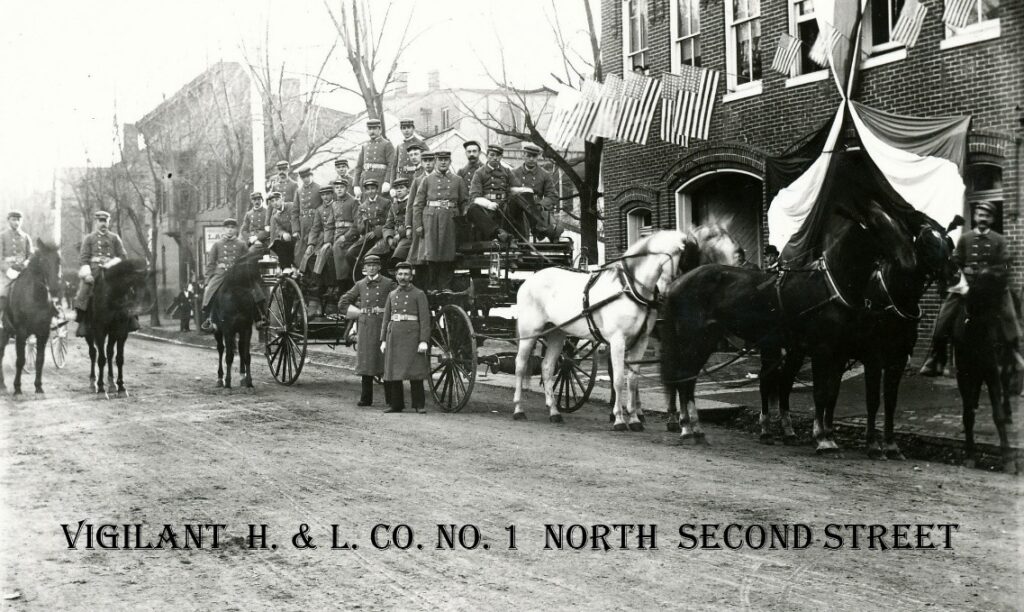
With the increased population in Chambersburg in the years after the Civil War, it became clear that additional fire protection was needed. All but one piece of fire apparatus was drawn by hand, and the Juniors and Friendships, despite their central locations, were having to make long runs to get to the fires. The first lack to be addressed was the absence of a hook and ladder company. The Vigilant Hook and Ladder Co. was formed on August 10, 1876. Council built them a station on North Second St. opposite the Junior house. The Vigilant’s quickly became an essential part of the department. Later the Junior house was enlarged and the Vigilants and Juniors shared a station until the two companies merged in the later 1800’s.
The residents of the 3rd ward saw the need for a fire company in their section of town, and on May 30, 1877 a meeting was held in the School Building on West German St. (now West Liberty St). Led by John C Gerbig, they elected officers and named the company the Third Ward Hose Co #3. Bietsch cites that a number of men resigned from the Friendships to join the new company. By August 1st they adopted a constitution and Bylaws, electing officers for a term of 6 months. A small hose house was built on the northwest corner of Black Alley and German St. The Borough gave them the old White Swan hose reel from the Friendships and 500 feet of hose. Rodgers & Co. (Chambersburg) remodeled and repainted the hose reel in a clear white, with blue and gold striping according to the Public Weekly Opinion of July 3, 1877. Their first fire is listed at Water St. near Liberty, but no details or date are given. The name was changed in 1898 when the company was incorporated to Good Will Steam Fire Engine and Hose Co. #3. The company holds the name to this day.
The last of Chambersburg’s volunteer fire companies was started Oct, 15, 1877. They chose the name Cumberland Valley Hose Co. since most of their members were employed by the Cumberland Valley Railroad. The company grew very quickly, listing 40 members by November of 1877. The CVRR was pleased and supportive of a fire station so close to their operation. The CV’s first house was a 20×16 building located on North 2nd St. across from the Corpus Christi School. This was their home for 23 years. Council also purchased a 4 wheeled hose reel for $225.00. By 1900, a committee was selected to look for better quarters. Ultimately a lot was chosen in the first block of Broad St. The purchase price was $390.00. The CV’s contracted for a new house to be built on the site for $3600, and George Nitterhouse, master carpenter or the CVRR, was the supervisor. They would become the only fire dept. to own their station, at least for while! The CV’s struggled to pay the mortgage, including holding fairs, renting the second floor to the YMCA, and, according to some sources, held the occasional chicken fight in the basement. The CV’s original apparatus was a small, 4 wheeled, hand drawn hose reel, purchased by Council for $225.00. A year later they purchased 200 feet of leather fire hose. The CV’s used this hose reel from 1877 until 1903, using solely plug pressure, connecting the hose directly to the hydrant.
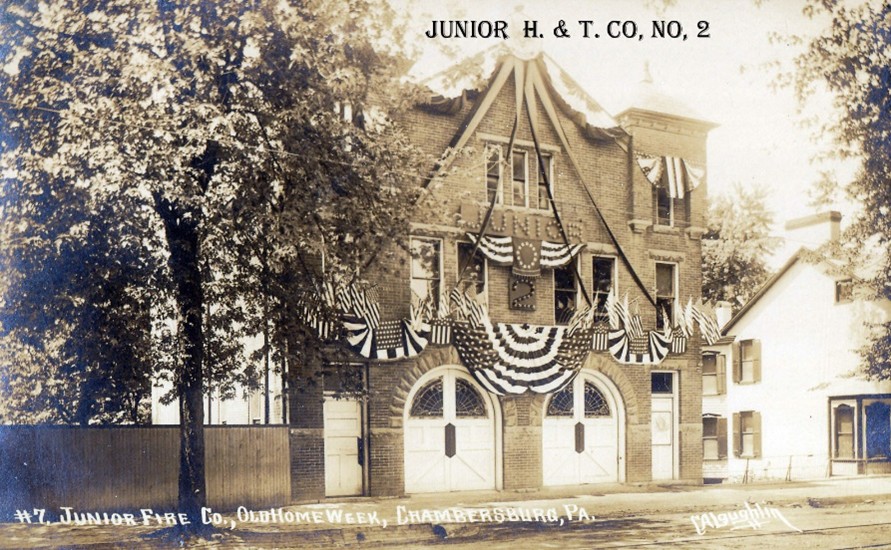
The 1880’s saw new fire stations for the Juniors and Good Wills. Council contracted to build the Juniors a frame station that they would share with the Vigilants on North Second St. in 1883. It turns out that the neighbors did not want a frame house, so a brick structure was ordered. Both companies occupied the house, one on each side, until they merged July 12, 1897 and became the Junior Hose and Truck Company. In 1886 the old 4 wheeled hose reel was replaced with a new 2 wheel reel, their only apparatus for many years. By 1887 they were officially known as the Junior Hose Co. #2.
Due to the small size of the original Good Will fire house, a committee was formed to work with Council on a new firehouse in 1885. The last meeting at the old house occurred on March 2, 1885, and soon they were settled into the new house on Catherine St. The old fire house was moved to the corner of German St. and Central Alley, where it still stands as a private residence to this day. According to the Franklin Repository of Mar 28, 1885, Joseph Winters was contracted to move the building.
The Chambersburg Firemen’s Union was established on June 10, 1887. This was a popular concept at the time as the growing towns with multiple volunteer fire companies needed to have a way to coordinate the efforts of the volunteers. Each company would elect three delegates to the Union and they would vote on matters as instructed by the membership. Meetings were held monthly, rotating through the fire houses. The Firemen’s Union would each year elect a Chief Engineer and Assistant Engineer, today referred to as the Chief and Asst. Chief. These positions were to replace the Fire Marshall, a position appointed by Council without consulting the companies. (Records show that Council did not discontinue the Fire Marshal position.) Due to the intense competition between the volunteer companies, there was a great deal of criticism and name calling in the months leading up to the election, similar to the Presidential elections of the 21st century. As time went on the situation got worse, with disagreements over everything from who was elected to how they were elected.
The Firemen’s Union elected Clay Henninger as the Chief Engineer on October 6, 1887. Bruce Snyder is elected Assistant Engineer. They will both serve until the new year when elections will be held for Chief and Assistant Engineer for the entire year.
On October 18th the Firemen’s Union establishes the Firemen’s Rules. The long list of rules was published in the newspaper. Rules 13-15 pertained to the issue of keeping the public out of the way of the firemen at fires. Each company was instructed to appoint 3 policemen who would rope off the incident scene and keep the public back. While not an official organization at the time, this was essentially the start of the fire police.
By December they had adopted an official badge. The cost to each member for his badge was 15 cents. In January of 1888 Clay Henninger is reelected Chief Engineer. Bruce Snyder did not run again, resulting in John K. Berger of the Hopes being elected Assistant Engineer.
A fire broke out at Weldman’s Shoemaker Shop on East Washington near Third in January of 1888. While the building was destroyed, the firemen performed “efficiently”, and the ropes and police kept civilians out of the way. Burgess Shillito, in a speech as the Hope banquet a few days later, said the fire was better managed, and there was less water damage.
One of the problems encountered in the early days of the fire service was an efficient way to alert the firemen to the presence and location of a fire. The ringing of bells was commonly used, and Chambersburg was no different. Each fire house had a bell, and it was rung to give the alarm of fire, and also to call members to meeting. The bell was effective at alerting the town, but not so useful at announcing the location. In May of 1879, the Good Wills establish a fire alarm system to avoid the general confusion caused by haphazard ringing of the fire bells. It starts with 20 taps of the bell, then indicates one tap for the first ward, two taps for the 2nd ward, 3 for the 3rd, and 4 for the 4th. Each of the second round of taps should have an interval in between. This system was adopted 9 years later (1888) by the Fireman’s Union.
Occasionally the entire town was engaged in the transmission of a fire alarm, as indicated in this article from 1896 in the Franklin Repository: Mar 5, 1896 TB Woods erupted in fire, the third fire of the night for Chambersburg Firemen. (The first was a home, the second a stable). The whistle at the light plant was blown, and Locomotive 41 was run out on the turntable and the whistle cord tied down. Greer Flack pulled the cord on Locomotive 44 until it broke. (Ed. Note – the locomotives were generally referred to as engines, however the word locomotive is used so as not to be confused with fire engines.) The courthouse bell was also rung, and a call made to the telephone station. The fire was in the 1st and 2nd floor of the new office and in the NW corner of the large brick machine shop. It moved into the old office that adjourned the new, and the main building at the pattern end. The fire was caught soon after that.
By 1888 the firemen were engaged in a conversation with the Borough regarding a modern, electric fire alarm system. The Firemen’s Union also petitions the Firemen’s Assn. of PA to work on legislation requiring municipalities to get fire alarm systems. The Union met with electrician Blair, about the cost of a system that he has recently patented. According to the newpaper, it is “cheap”. (Referring to price, not quality!) The “conversation” continued until 1904, when the Gamewell System was purchased and installed throughout the main portion of town.
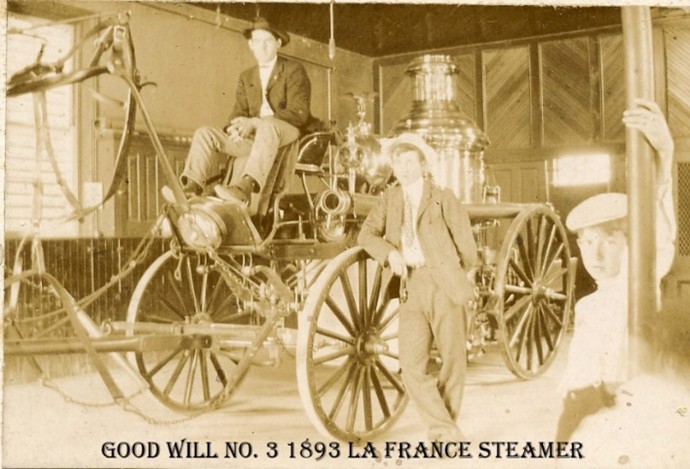
By 1891 the Good Wills see the need for another steamer. They try to raise the funds to buy it themselves, but at a price of $3200.00, it would have taken years to accumulate the funds. They made a deal with the Borough – they would purchase new hose with the funds raised, and the Borough will buy the steamer. The steamer was ordered on Oct. 7, 1892, and arrived on February 7, 1893. The first fire for the new steamer was at Rev. J. K. Bricker’s stable, located off Broad St. At this time, despite the fact that the steamer was meant to be pulled by horses, no one had purchased horses, nor did the Good Wills have a place to house the horses. The steamer was thus pulled by hand, and it was heavy work. Efforts were made to raise the money for horses through subscriptions, raising about half of the needed amount of $236.00. The horses were not purchased right away as there was still no stable to house them. A contract was made with a local businessman to use his team of horses. The horses were to be made available to the Good Wills immediately when they were summoned by the fire alarm, but in between they would continue to pull wagons, etc. for the owner. This continued until the Borough was able to secure a land near the Good Wills house and build a stable in 1906. The Borough, however, was still opposed to keeping horses only to pull the steamer. Their solution was to send the firemen with the horses, to pull borough wagons to pick up trash and clean streets, among other duties.
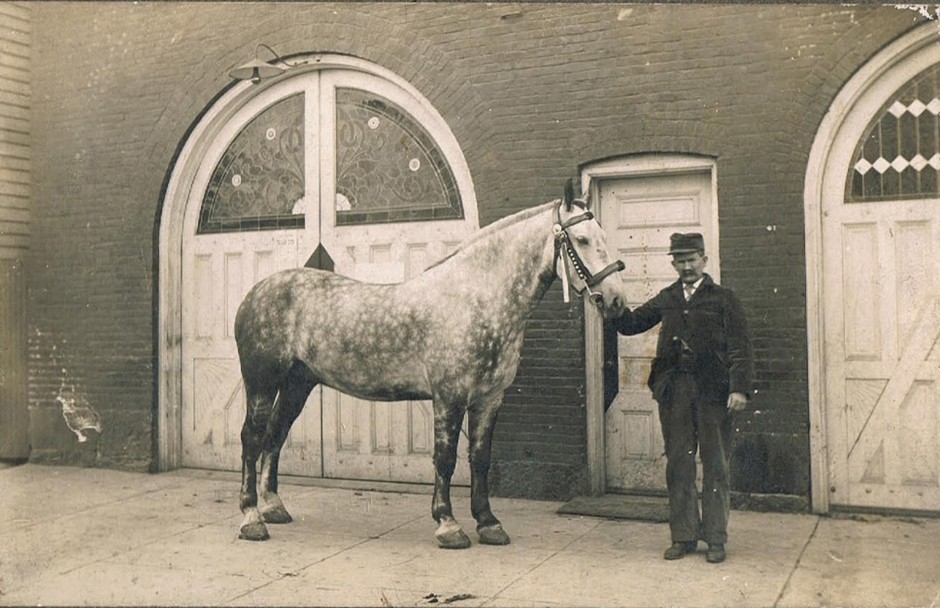
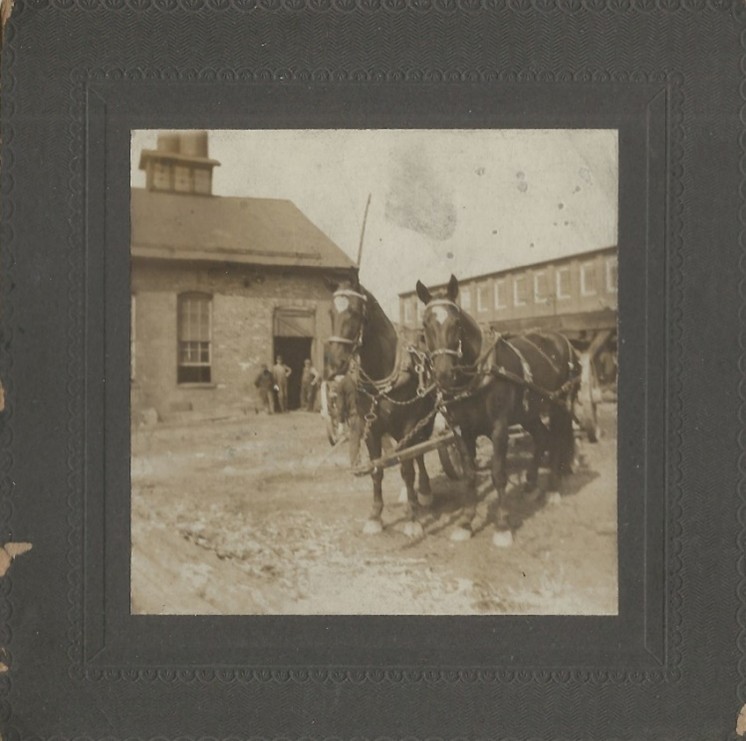
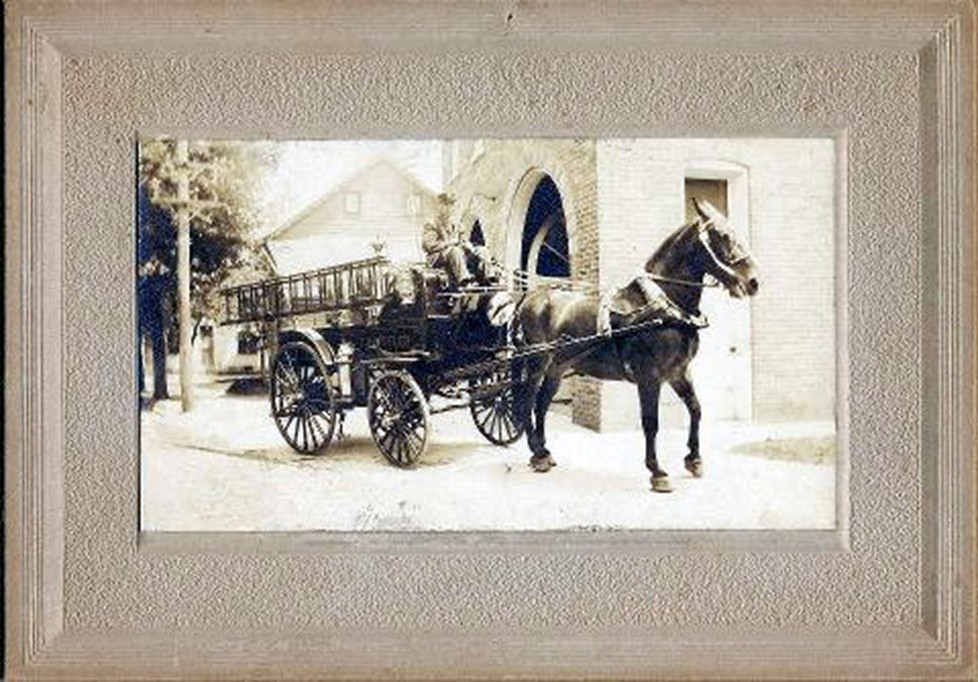
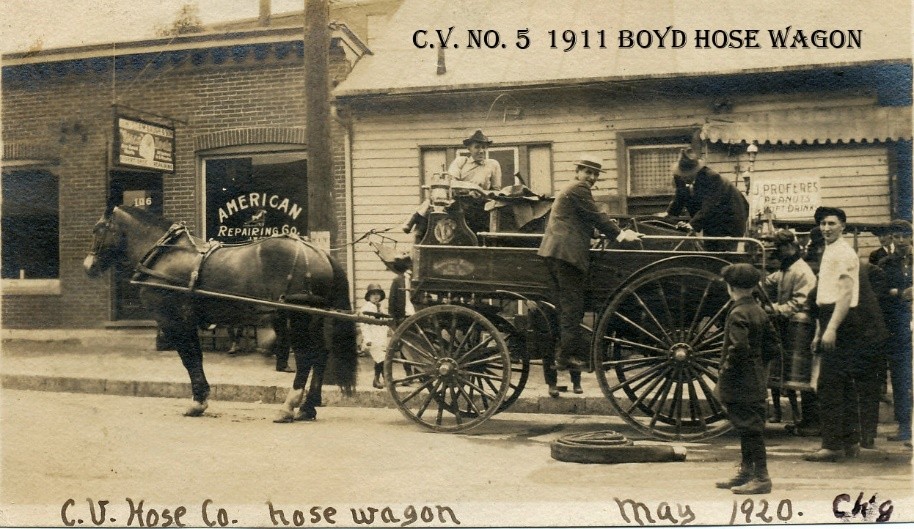
1890s to 1925 – Horses and Locomotives. Up to this time in Chambersburg, most fire apparatus was moved with manpower. Imagine grabbing a hose reel, fire engine, or ladder truck and running with it to a fire. Then you had to fight the fire. Then you had to walk the apparatus back to the station and clean up. By this time the fire apparatus was getting larger, and horses were becoming necessities. The era of horse drawn fire equipment in Chambersburg was short, but the horses quickly became part of the “team”, and were known and loved by the firemen and community alike. Motorization signaled the end of the horse era. By 1925, the last fire horses were sold when the CV’s and Franklins received motorized pumpers.
The following story is copied verbatim from M. L. Marotte’s booklet “Chambersburg’s Fire Horses: Ever Faithful”:
The company in 1911 placed into service a new hose wagon made at Philadelphia, Pa. and a black horse by the name of “Sam” was assigned for duty. After Sam’s years of service “The Ever Faithful” fire horse was retired and sold to a creamery in Baltimore, Maryland
One day while the milkman was making his deliveries Baltimore fire apparatus had raced by “Sam” causing him to become anxious and he had followed along with the milk wagon in pursuit to the fire scene. When the milkman returned from his delivery he noticed that “Sam” and the milk wagon were gone. The milkman followed the trail of milk bottles in the street to the fire ground where “Sam” was standing. The Cumberland Valley Hose Company became motorized in 1925. (Snider also reports this story in his CV’s in Review from 1967)
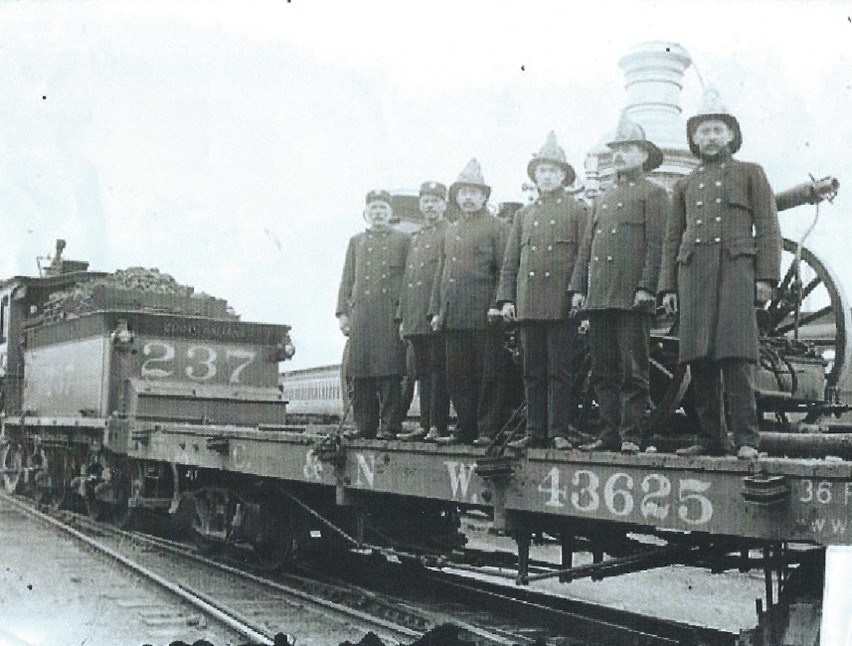
It was primarily during the horse era that the railroad became a transportation option for the firemen. The Cumberland Valley Railroad (CVRR) was incorporated in 1831, and was completed to Chambersburg in 1835. The railroad initially went only to Harrisburg, but continued to expand to local towns. The CVRR had shops in Chambersburg, and were able to build and repair locomotives and cars. Much of this was burned in 1864 during when Jubal Early burned the town. By the 1870s the CVRR connected much of Franklin County, as well as Hagerstown, MD. The railroad carried freight and passengers, and was the fastest way to get around, even for firemen. When another community along the railroad had a large fire and needed help, the railroad would transport the firemen, horses, and apparatus. July 23, 1890 saw a huge fire at the Jones and South Warehouse in Hagerstown. It took only 40 minutes from notification to water on the fire for the Chambersburg Companies, with the help of the CVRR.
On March 26, 1895 a fire broke out in the west wing of Wilson College’s Old Main building around 0730. The CV’s hooked to the plug in front of Mr. Nelson’s home and had a stream on the fire. The Good Will Steamer pumped from the Conococheague in the rear of the college. The Chief Engineer, G Fred Gibbs, a member of the CV’s, directed the operations. It took about two hours to extinguish the fire, with damage confined to the roof and upper floors. The total loss was $3000.00. Wilson later presented the entire department with badges, each with the company name and number, and CFD on the badge, allowing 50 per company. These were used as the department badges for a period of time, but allowing that only 300 total were made, they were eventually discontinued as the dept. badge. There is a picture in Bietsch’s book. (I have never seen one in person.)
Firemen’s Relief Association: On July 3, 1895 a special committee of the Firemen’s Union is appointed to prepare the way for the organization of the Fireman’s Relief Association in Chambersburg. The committee, composed of Christian Frederick, R. E. Hazelet, and Daniel Leisher will work to ensure that the Relief organization is in compliance with the firemen’s pension bill that was passed by the legislature. A suggestion was also made to form a burial fund. At first the committee is unsure about the value of the Relief Organization, but as the rules started to become more clear, they were instructed to continue looking into setting up the organization. By October the Committee realizes that in order to receive the money from the foreign fire tax, they will need to set up the Fireman’s Relief Association. The matter is sent to Council for approval, and to write the ordinance. On January 1, 1896, The Chambersburg Firemen’s Relief Organization is formed, and the Constitution and Bylaws as prepared by the state firemen’s committee were adopted with a few minor exceptions. The Association still exists today, with 10 or so members from each of the companies. Relief purchases safety and protective items for the firefighters, as well as tools and equipment. Relief pays for firefighter training for the volunteers, and carries an insurance policy on all active volunteers. It also provides a death benefit.
Part III: The Next Generation:
The Cumberland Valley Volunteer Firemen’s Association: In the midst of a dispute between the Borough and the fire companies about who may go out of town with Borough apparatus to fight fires in neighboring communities, a huge fire breaks out in Shippensburg. It is August 3, 1901, and the Boher Furniture Factory and the Methodist Church are on fire. The Chambersburg companies were requested, and thanks to the agreements with the CVRR, they proceeded via train to Shippensburg. They encountered a serious problem: They could not connect to the fire hydrants due to different threads on the hose couplings.
This was the failure that prompted the formation of the Cumberland Valley Volunteer Firemen’s Assn. J. F. Boyd, superintendent of the CVRR realized the need, and called Burgess J. A. Hamilton of Chambersburg to write to the Mayors of Winchester, Martinsburg, Hagerstown, Greencastle, Mercersburg, Carlisle, and Mechanicsburg to attend a meeting at the Junior’s parlor on North 2nd St. The matter of adopting a uniform coupling for all towns in the valley was approved, and the CVVFA was born. They used the “Cumberland Valley Thread” until the 1970’s when the National Standard Thread was adopted.
The Fire Police are formalized as a part of the fire department on July 23, 1902. Each company is required to have 3 fire police. They have power to arrest pillagers and assist with keeping order, and each must be sworn in. The fire police still exist as an organization, although the arrest powers have been revoked. Their primary job now is to protect firefighters from citizens in their way, and more so from vehicles that aren’t paying attention.
Meanwhile, back in Chambersburg…Some of the companies are still pulling heavy hose wagons by hand. There is no standard badge for the department, there is no modern fire alarm system, and the fire companies are squabbling. The Borough is working on a new fire station for the Hopes. At the end of 1902, Council decided to table much of the controversy, and leave it to the new Chief Engineer to settle. Needless to say, this was not a good plan.
The Firemen’s Union had an argument about who was properly elected Chief Engineer, so ultimately the Borough appointed their own Chief Engineer. The Hopes refused to acknowledge this Chief, and were disbanded by the Borough for insubordination in early November. The CV’s felt that since the rules of the Firemen’s Union were still in effect, the Borough did not have the authority to select a Chief Engineer. To settle the dispute, they recommended that the Borough disband the Firemen’s Union. At this time the dispute was settled by a better set of rules for election of the Chief Engineer, and the Borough appointed Chief was recognized. After much discussion the firemen agree that they don’t want to resurrect the Firemen’s Union, and ask that Council develop the rules and pass an ordinance to regulate the fire department. They meet with the special committee that Council has appointed to draw up the rules. After clearance by the lawyers, the ordinance goes to a vote.
In November of 1904 Council passed the first ordinance prescribing the rules and regulations of the Chambersburg Fire Dept. This ordinance stated that on the first Monday of March, every year, the Chief Burgess will appoint the Chief Engineer of the Chambersburg Fire Department. The Chief Engineer was to be chosen from the membership of the 5 Companies of the CFD, and must have been an active fireman for at least 5 years. The appointment must then be confirmed by a vote of Council. The same rules applied to the appointment of the Assistant Engineer. The rules also stated that the Companies from which the Chief and Assistant Engineer were chosen had to rotate every five years, and the Chief and Assistant shall not be from the same company. The Chief and Assistant may not succeed themselves. The 22 sections of the ordinance then go on to define the duties and responsibilities of the officers, and specifies that only members who wear the department badge may ride the train to out of town fires, and that each company shall have equal privileges in attaching hoses to one of the steam engines. (Published in the Franklin Repository, Nov 11, 1904)
In the midst of all the drama of 1903, a number of positive achievements can be noted. In 1903, Council purchased a chemical engine for the Juniors, drawn by the famous Doc and Derby. These two horses were named after two well respected citizens, Dr. John Greenawalt and Councilman Harry Derbyshire. Doc and Derby were kept until motorized equipment was purchased for the Juniors during World War I (1917). The horses were sold to the army, and continued to serve in France pulling artillery for the army. Both horses were killed during the war, and never returned to the US.
During the same year, the CV’s wanted Council to buy a steamer, citing the need for one on each end of town. Council initially was concerned about placing a Borough owned apparatus in a privately owned fire house. The CV’s agreed to sell the fire house to the Borough for the $3600.00 that it cost to build. Council agreed. The steamer cost $4600.00, and was purchased from the LaFrance Manufacturing Co. of Elmira, NY. The new apparatus has a steam operated piston pump capable of throwing up to 750 gpm. The original engineers were Elmer Speer, Kenneth Burkholder, and John Stambaugh. The drivers were Roy Stout, H. Miller, and Lewis Crist. Three firemen total could ride the steamer, and 6 were allowed on the hose wagon. Remaining firemen were still running to the fire on foot!
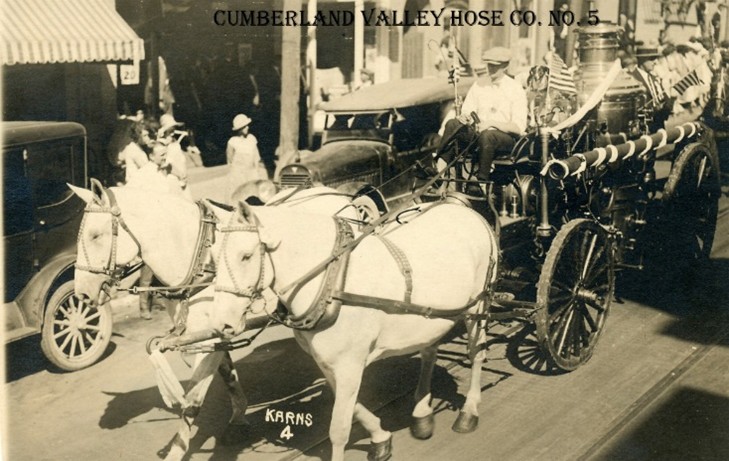
A stable was added to the rear of the fire house to house the horses needed to pull the steamer. It cost $564.11, and was constructed by Keagy and Lochbaum. The horses were Pat and Charlie: Purchased in 1903, they pulled the steamer until 1921. They were replaced with the Good Will horses Cap and Tom as the Good Wills motorized in 1921. Cap and Tom remained with the company until 1925 when the CV’s were motorized.
One of the final acts of 1903 was the formation of a new fire company for the 4th Ward. On December 11, 1903, the citizens of the fourth ward organized the Franklin Fire Co. and they soon occupied the new station built for the Hopes. T. Z. Minehart, a prominent attorney, lead the company for many years. Another well known member of the Hopes, Francis Kuss, also joined the Franklins. Mr. Kuss served his community from 1887 to 1903 with the Hopes, and from 1903 to 1954 with the Franklins. The Franklin’s immediately distinguished themselves as a superior firefighting organization with great community spirit that was not limited to the extinguishment of fires. They received a new horse drawn hose wagon, pulled by Harry, then Frank. Frank faithfully performed his duties until he was retired in 1923, according to M. L. Marotte.
The Fire Alarm System, part 2: The Gamewell Fire Alarm System is finally installed in Chambersburg in 1904. The fire companies and the community were using the fire bell as an alerting system. The fire bell had been used since the early days to alert the firemen and the community to a fire. The problem with the system was that the bell was often rung incorrectly, sending the firemen to the wrong side of town. The Gamewell system consisted of an alarm box that, when activated, sent a signal to the proper fire station, alerting the crews that there was a fire in their district. Each alarm box had its own number, and when the alarm was pulled, it rang out the box number on an Indicator, located in each fire station. The Indicator also would show the box number using numbers on reels. This provided a visual reference for anyone who missed the bell. Note that the fire service still uses “box alarms” to this day to indicate an incident that requires more than just one company.
The Gamewell system started with just 10 boxes, mounted on telephone poles at strategic corners. By the time it was discontinued in the 1980’s, there were over 80 boxes. Each station had a wall size chart that listed each box and its location. Most of the drivers, of course, did not need to look at the wall to know where the box was. The institution of the 9-1-1 system signaled the end of the Gamewell Fire Alarm System, although it had started to be phased out due to advances that included house sirens, personal fire pagers, and of course, the telephone. Today, most volunteer firefighters are alerted on their smart phone.
The first alarm on the Gamewell system was on July 1, 1905, for a house fire at a double house owned by Christian Burkhart, located on Gas Alley (now Burkhart Ave.).
In 1905 the 5 companies of the Chambersburg Fire Department adopted official colors.
The Good Wills received a hose wagon to replace the White Swan in 1906. They promptly requested a horse and harness to pull the hose wagon. “Bill” pulled the hose wagon from 1906 to 1913, when he was replaced by Cap and Tom. Maude and Sam were pulling the steamer at this time. They used this hose wagon and steamer until 1921, when they were replaced by a motorized combination pumper. Two of the horses were taken to the CV’s to pull their steamer, one from the steamer and one from the hose wagon. The other two horses were sold.
May 1, 1907 at 0600 the JA Hollinger Planing Mill on Broad St. burned to the ground. It was the worst fire since the burning of Chambersburg, according to Snider. Hagerstown sent 2 pieces of equipment. Both Chambersburg steamers pumped for over 12 hours. The mill was a complete loss with damages set at $135,000.00, as per Snider. The Public Opinion reports that Chief Engineer Harry Smith of the Good Wills did a great job, as did the firemen. Contractors and railroad employees assisted as well.
April 8, 1908: Multiple stables in Central Alley were burned, those of the National Hotel and Hotel Montgomery being among them. The fire department was delayed because all of the fire horses were at the west end of town, hauling dirt. All the teams had to be driven to their station, unhitched from the wagons and re-hitched to the steamers and hose wagons before heading to the fire.
Part IV: Motorized
The 20th century is known for the rapid pace of advancements in science and technology. The advent of motorized apparatus made the firemen’s job easier as they could get to the fire more quickly. They no longer had to take care of horses, and the apparatus provided a ride for the volunteers, so one no longer had to run to the fire.
The first motorized apparatus in Chambersburg was purchased for the Friendships in 1911. The American LaFrance Combination Chemical Automobile Apparatus served the Friendships until 1930. In 1930 the Borough purchased an American LaFrance City Service Truck for the Friendships. This is the year that they moved to their new station.
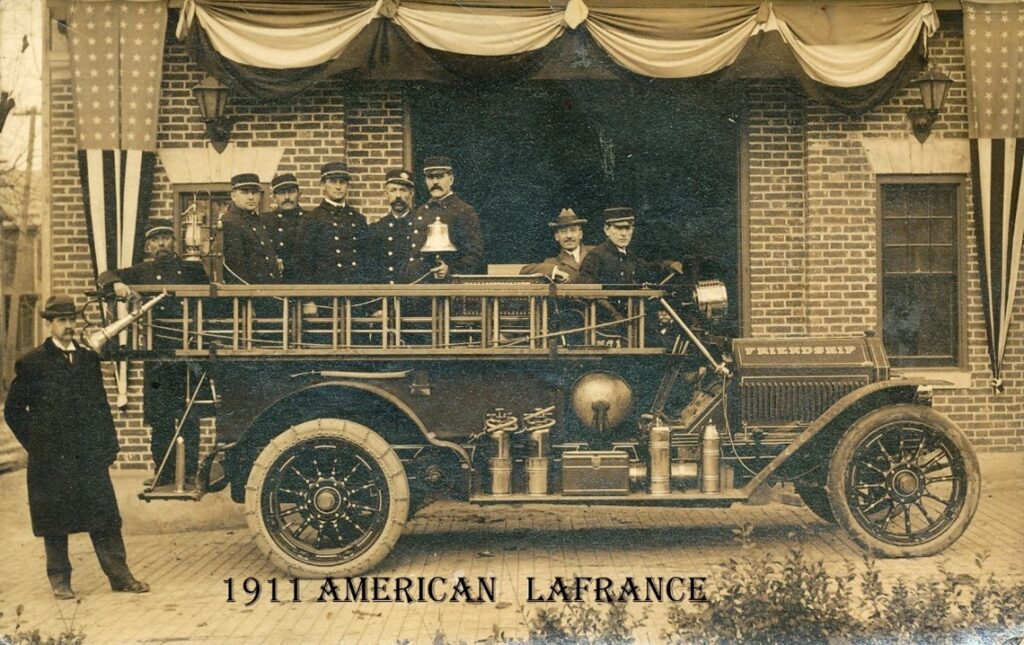
October 1952: The Borough buys the Friendships a Ford American pumper, 500gpm. This truck is also referred to as an American March. The company also puts into service a Dodge panel rescue and salvage truck. In 1958 they get a Dodge Rescue and Salvage Truck, initially purchased by the company and soon turned over to the Borough, although it remains assigned to their station.
Mar 15, 1962, the Friendships places in service a new American pumper on a Ford Chassis with a 750 gpm pump. Purchased from the Glenn D Culbert Fire Equipment Co, it is described in their 200th anniversary book as an American LaFrance.
In 1917 two motorized pieces were purchased for the Juniors. The aerial hook and ladder truck and the chemical engine were both Seagraves. After a discount for trade on of the old chemical wagon, and 5% for buying two at once, the $15,050.00 price dropped to $13,846.25. The apparatus was housed in the Junior house on October 1, 1917 after renovations were finished. The Franklin Repository states that the “tillerman was in his chair and had no trouble at all” as the truck was backed into the station for the first time.
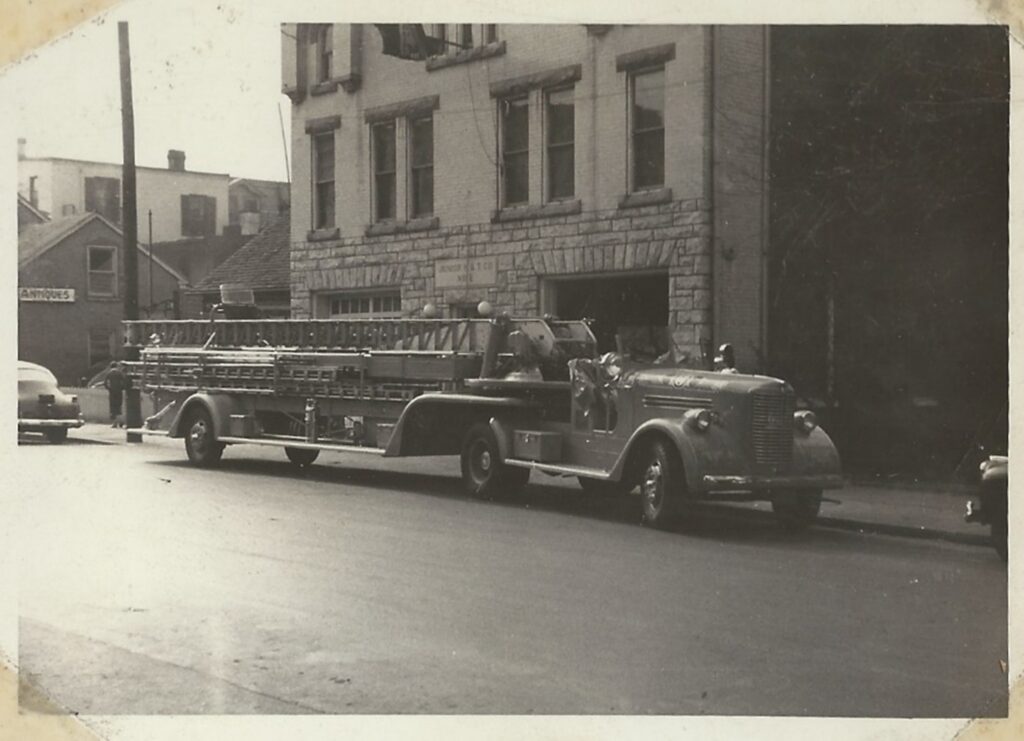
The Ward LaFrance Service Truck was purchased for the Juniors in 1936. In 1941 the Peter Pirsch Aerial (Tiller Truck) was purchased for the Juniors, replacing the 1917 Seagraves. The cost was $17,000.00.
June 14, 1965 the Juniors get a 1000 gpm Peter Pirsch pumper, replacing the 29 year old Ward LaFrance Service Truck.
The Good Wills received a 1921 an American LaFrance triple combination pumper, motorized, from the Borough. The “triple combination” was a pumper, chemical engine, and hose carrier. It cost $12,500.00. During acceptance testing was able to pump 800 gpm, and they say that 29 firemen climbed aboard at the same time!
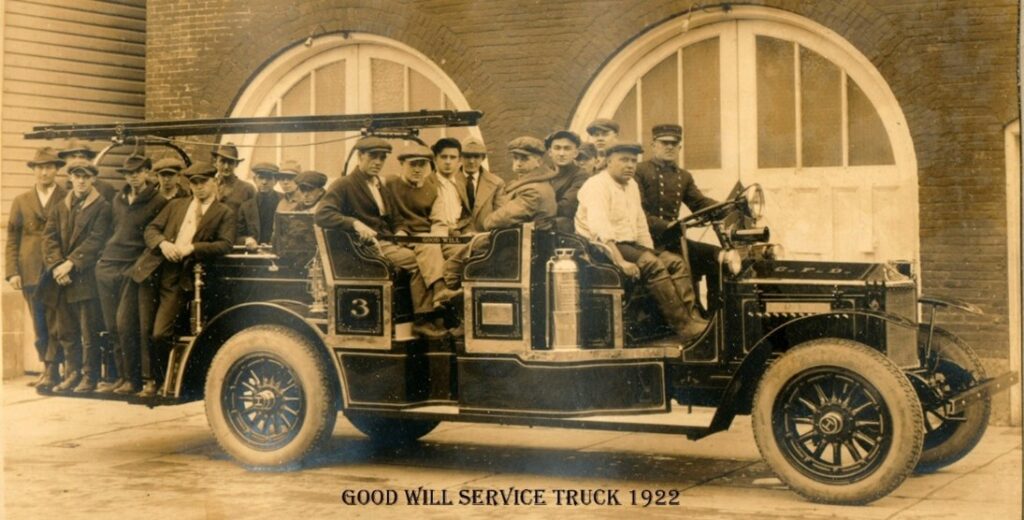
This pumper responded to its first fire on Sept. 21, 1921 at the Indian Queen Hotel (Hotel Lamar in 1944). Russell Kyle was the first driver of the new pumper. The Good Wills also purchased a Hurlbert Service Truck in 1921, built by H. B. McFerren of Chambersburg, paying for it out of their own funds, as Council had already purchased the steamer. The Service Truck was used for transporting members to and from incidents. The truck was housed on Nov 4, 1921, with the approval of Council, even though the company owned it. The service truck’s first incident was on Nov. 5, 1921, driven by Harvey Gladhill. By 1922 the company was adding tools to the service truck, to include a chemical tank, siren, and bell. The chemical tank was used for the first time on Oct. 15, 1922 at William Jacobs house on Garfield St.
The Hurlbert Service Truck was in service until 1937, when it was deemed time to replace it. The Good Wills sent a committee to Council, who agreed to set aside $5000.00 to replace it in the 1938 budget. The Borough then encountered some large expenses for upgrades of infrastructure including improvements to the sewage plant and water lines, so the new service truck was postponed until 1940. The Borough purchased a Peter Pirsch Squad Car, as recommended by the Good Will’s committee. The truck arrived on Jan 10, 1941, and was placed in service on Jan 11, and by Jan 14 had answered its first call, a chimney fire on West Liberty St. It was driven by Ralph Johnson, and remained in service until 1975. This truck was painted fire engine red with gold leaf details. (Note, this is first mention in Bietsch’s book of a paid driver – the regularly employed Good Will drivers, as well as 4 qualified volunteer drivers are permitted to operate the Squad Car). The Hurlbert’s last call was 11/24/40 at a fire at the People’s Drug Store, alarm box 22, driven by Merle Kauffman.
In 1953 the Good Wills receive the 750 GPM Oren, painted fire engine red.
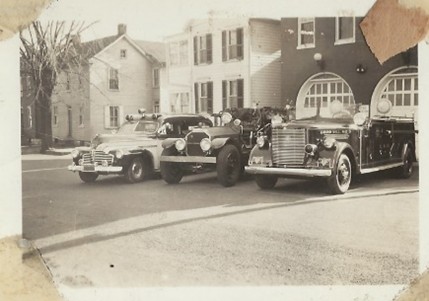
Rules for drivers were established in 1923, including, among others, that you had to have a driver’s license, and you were required to never exceed the speed limit of 25 MPH at any time.
1925 “Old Mike”, a new American LaFrance pumper was purchased for the CV’s. The floor of the fire house had to be finished in concrete, and the stables were removed. The stables were replaced with a first and second story addition. The rear portion of the station was the rec room, and the second story addition provided a sleeping area, kitchen, and facilities for the drivers, since they were on duty around the clock.
The last fire at which the steamer was utilized was the Central Presbyterian Church fire on Oct. 27, 1938. The steamer was pulled to the square by “motor truck”. The steamer still resides at the Chambersburg Volunteer Firemen’s Museum thanks to the generosity of the American LaFrance Co. The steamer was traded in on “Old Mike”, and American LaFrance donated the steamer back to the company.
In 1947 Old Mike was placed in reserve as the Borough purchased a Mack pumper for the CV’s. This pumper was painted a robin’s egg blue to reflect the company colors, and has been known as the Blue Goose for as long as anyone can remember. The Blue Goose was the only 1000 gpm pumper in the Borough until 1965. The Reeder Hotel fire was the last incident at which Old Mike responded, on April 13, 1961. It is interesting to note that two-way radios were not purchased for the CV apparatus until 1958.
The Franklin’s received a twin to Old Mike, and in fact the two 1925 pieces have consecutive serial numbers! The Franklin’s receive an American LaFrance pumper with the cab ahead of engine design on January 4, 1955. This pumper replaces the 1925 American LaFrance as the Franklin’s Borough pumper. The Juniors 1936 Ward LaFrance is now the oldest piece in the Borough. The Franklins inherit the 1952 Ford American March from the Friendships in early 1962, as the Public Opinion notes that the apparatus the Franklins operate in the Borough are the 1952 and 1955.
Feb 15, 1927: The Borough passes an ordinance for the governance of the fire department. This is the first update since the initial ordinance was passed in 1904.
The CV’s established a Women’s Auxiliary in 1934 who assisted with fundraisers and also marched in parades. The first Officers were President Mrs. Ray Michaels, Secretary Mrs. John Hoover, and Treasurer Mrs. John Stambaugh. The auxiliary was disbanded in 1948, according to Snider. No details are provided. They wore a uniform similar to that of a nurse, with blue capes and hats, and white shoes. The Museum has one of the capes on display. Newspaper reports from the 1970’s show that the CFD Women’s Auxiliary has become quite active again. More research is needed to determine when they reactivated, and for how long they remained active.
June 24, 1955: CFD receives their FCC License, with the call letters KGD 611.
By the 1950’s Goodwill’s house on Catherine St. was having structural issues, possibly due to all of the additions over the years. The stairwell on the east side was pulling away from the rest of the structure. It was determined that a new station was in order, and much discussion followed as to style and location. There exists a drawing of a handsome new station located on South Second St, but a property on East McKinley was available: it was an old garbage dump, located just west of the high line. While the location was being worked out, the situation was deteriorating at the Catherine St. station. The west wall continued to buckle as a result of shifts in the foundation. In March of 1958, the apparatus was moved to the Junior Fire House.
Council ultimately chose the McKinley St. location and ground was broken on March 18, 1959. The proposed cost for the station was $68,715.00, however the Public Opinion reports that the final total was $88, 250.00. The Good Wills moved into the station on November 28, 1959.
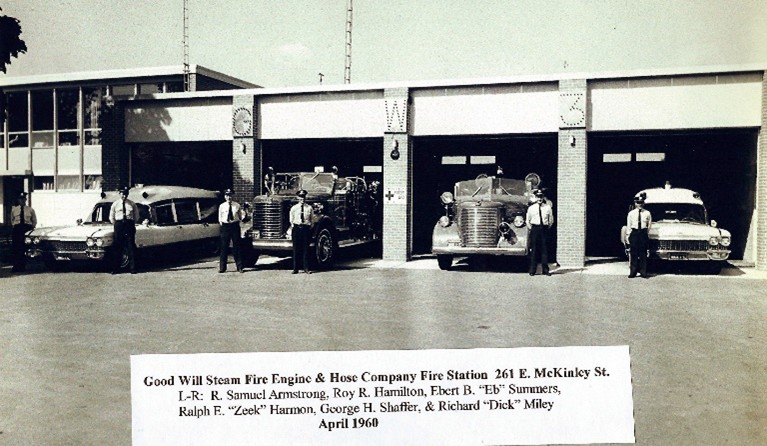
Nov. 15, 1960: The paid firemen send a letter to Council advising them that they have organized as the Chambersburg Paid Fire Apparatus Drivers.
1971: Fire Chief John “Stiffy” Shatzer was reappointed to his 20th year as Fire Chief. He would remain the Chief until the Borough hired the first paid Chief in 1974.
Part V: Ambulance
Ambulance service in the area was started in 1908 by the Chambersburg Hospital. They purchased a horse drawn ambulance for $600.00. In 1916 the ambulance body was mounted on a Ford motor chassis. This ambulance served the community for about 8 years, at which time it “had seen better days” according to Marotte. On August 15, 1924 the Good Wills held a special meeting to discuss the ambulance. Russell B. Kyle, a Good Will member and driver, felt that the fire company should be the one to purchase and operate an ambulance, providing the service free to residents of the Borough of Chambersburg. After some discussion with the Membership and Borough Council, it determined that Council would pay for the upkeep and maintenance if the Good Wills paid for the ambulance. Council would also allow them to house the ambulance at their station. An ambulance was ordered from H. B. McFerren of the Garford Motor Co. on November 15, 1924. Mr. McFerren was from Chambersburg, and his shop was located at South Third St. and Harrison Ave.
The new ambulance was completed by May 15, 1925, and was dedicated on the west lawn of the hospital. The total cost was $3500.00. This ambulance could carry 10 persons and a driver, was 22’6” long, 6’6” wide, and 7’8” long, with a 7 HP Motor, 6 cylinders, and 4 wheel hydraulic brakes. Inside, the side walls were birds eye maple, and the floor was quartered oak covered with mats. There was hot and cold running water, (using the heat from the motor), a washbasin, counters, and a cabinet. Six dome lights, skylights, and a ventilator on top provided light and air, and there was phone from the patient compartment to the driver. The unit was finished on the exterior in “pig skin brown” with dark gray striping and brown edging.
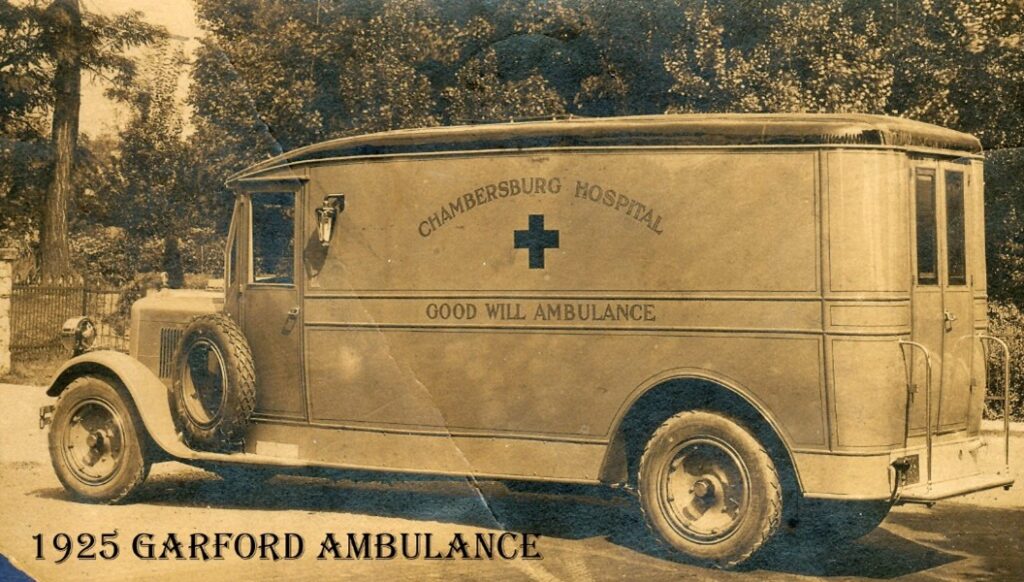
There was no charge to residents of the Borough. There were also no charges for emergency cases such as vehicle accidents. Charges for out of Borough residents were turned over to the Borough to assist with maintenance costs.
The first call was on 6/4/25. Mrs. Horn of East Catherine St. was taken to the hospital. Later in 1925 they added a rotary gong and shock “observers” (this as stated in Bietsch’s book), and the modern convenience of windshield wipers was added in 1930. In 1931, after a tragic incident in which several men died in the underground pit at the Chambersburg Gas Co. plant pit, they purchased 2 fume masks from Mine Safety Appliance Co of Pittsburgh. Later that year the squad truck received an inhaler with 2 extra tanks and cases.
The Garford ran 2,816 calls from July 4, 1925 through March of 1934, totaling 48,000 miles. By 1933 they were looking for a replacement. The replacement was a 1933 Buick put into service on 9/6/33. It answered its first call that day. This ambulance has quite a journey to get to Chambersburg. It was one of 4 constructed for the World’s Fair in Chicago. It turned out that three ambulances were sufficient, so this one was cancelled, however it was already well along in assembly. The Good Will’s got a discount on the $5,250 purchase price. This ambulance was on a Buick Straight 8 chassis, with a 158 inch wheelbase, developing 113 horsepower. The exterior is finished in desert sand tones and hemlock gray with black fenders. The length is 19’6”. This ambulance is only built to accommodate one patient, however the Good Will’s installed a collapsible cot so that two patients could be transported. Like the Garford, this one had a wash stand with hot and cold water and cabinets for supplies. There were two lights in the front with pairs of lights in the rear plus a dome light in the ceiling. An electric fan provides ventilation. The interior furnishings are walnut and leather, with doors on three sides. The Good Wills are keeping the name “Chambersburg Hospital Good Will Ambulance”, which will appear on the side windows, and a Red Cross is emblazoned on the panels, with a similar symbol on the glass of the rear door. The ambulance remains free to Chambersburg Borough residents and all emergency cases.
By 1941 the Buick had 80,000 miles on it, and the Good Wills were looking at a new ambulance. They commit $3425.00 for an ambulance from The Flexible Co. of Loudonville, OH, with the body to be mounted on a Buick Roadmaster chassis. This ambulance was metallic maroon and gray with a burgundy interior. It ran from July 25, 1941 until January 1, 1944 with a total of 2,584 calls. The grand total of calls from 1925 to Jan 1, 1944 is 11,181. (This is the year Bietsch’s book was published).
The Good Wills also started training their firemen for first aid. They held the first class in 1941. Each graduate received a first aid card from the Red Cross that was good for three years. This class was repeated yearly for many years.
The 1941 Buick Flexible ambulance ran for 11 years for a total of 6843 calls. In 1947 a second ambulance was purchased, also a Buick Flexible. In 1952 the 5th and last Buick ambulance was purchased, replacing the 1941 model. The company has run 21,039 calls with the ambulances since 1925. 1960 marked the first year of Cadillacs. Two were purchased with a red and white paint scheme. They ran for 3 years. When they were replaced in 1963, each ambulance has greater than 39,000 miles of service. The 1963 models were purchased from Gordon Coach and Ambulance Sales of Lehighton. They had the same red and white paint scheme, 4- 360 degree red lights, a beacon ray light, non-slip differentials, adjustable steering wheels, new folding chair stretchers, and seat belts. The cost for both was $14,400.00. By 1966 each has over 41,000 miles and will be traded in on 1966 models. The 1966 Cadillacs were purchased for $29,400.00 from the Miller Meteor division of Gordon’s Coach and Ambulance Service, keeping the bright red body with white top. The ambulances were replaced by Cadillacs again in 1969 and 1972.
The 50th anniversary of the Good Will Ambulance, in 1975, is marked by a major change. The cost of the purchasing the ambulances is becoming more than the Good Wills can afford, so it is in this year that ownership is transferred to the Borough of Chambersburg. From this year forward, the ambulances are completely the responsibility of the Borough.

Part VI: A New Era Begins
The Chambersburg Fire Department has had paid drivers for their apparatus since the end of the 18th century, with the advent of the big steamers. An article in the Valley Spirit of March 17, 1897 shows that the Good Wills had a paid driver for their steamer, and the driver was paid by the Good Wills, not the Borough. His salary was $298.40 for the year.
Waynesboro had a paid driver for their steamer in 1892, and they were already looking into an electric fire alarm system. (I do not know when they actually got their fire alarm system).
By 1909, it is clear that the Borough of Chambersburg is now paying drivers for 4 of the 5 companies. For reasons unknown the Friendships do not have a paid driver in 1908 and 1909. The other drivers are paid as follows, in the 1909-1910 fiscal year:
Juniors – $572.40
Good Will – $1081.63 (one might assume that they had two drivers)
Franklin – $481.89
Cumberland Valley – $572.39
All of the companies had a paid janitor, not a fulltime position, that paid $30.00 to $40.00 a year. The Borough also paid for feed, fuel, repairs, supplies, and ice. The Borough owned most of the apparatus and all of the fire houses.
There was talk at that time of combining companies and reducing the number of paid drivers, but amid great resistance by the fire companies, this was tabled. It will come up again!
In 1911, with the advent of motorization in Chambersburg, the need for paid drivers became even more important, because there was not yet a good structure for training and licensing automobile drivers. When you factor in the cost of a motorized pumper or truck, it makes perfect sense to have a trained, responsible person to operate the vehicle. Often, the driver just drove – the Company engineer operated the pump or ladder apparatus. The two jobs merged into one as time went on. Today, the certification for apparatus drivers is called “Driver/Operator”, and there is a separate one for a pumper and truck/tower. All through the years from 1911 until the early 1970’s, the paid drivers were an important part of the operation. Most of the drivers were also volunteer firemen with the companies, making them very much part of the family.
As we get into the 1970’s, the fire service is growing and modernizing, with a budding sense of safety for the firemen, bigger and more capable apparatus, the entrance of women into the fire service, and the expansion of the duties of the firefighters. Science and technology have started to provide the tools that will take the fire service into the 21st century, and the fire service of the nineteenth and twentieth century is becoming outmoded.
A study conducted by the International Association of Fire Chiefs (IAFC) is presented to Council in December, 1973. The study says that the Borough is not served by a fire department as such, according to the Public opinion. It states that the five fire companies have become so independent that their effectiveness is suspect. Essentially the department was still running as they had in 1903!
The IAFC report makes a number of recommendations, including the hiring of a professional, paid Fire Chief, abolishing the Council positions of Fire Marshall and Asst. Fire Marshall, the consolidation of the 5 stations to 3, and paid drivers being classified as professional firefighters who would be supplemented by the volunteers. It goes on to say that the Friendships should be moved into the Good Wills station on McKinley St., and the Juniors and CV’s move into the new centrally located station that is already planned. The Franklins will be left alone due to their strategic location on the west side of the Western Maryland Railroad tracks. The study went on to make recommendations about the training program, staffing the ambulance, replacing apparatus, and establishing a fire museum.
Needless to say, most volunteers and many Councilmen were shocked at the dismal picture painted by the study, except for Fire Marshall Deardorf, who personally agreed with the suggestions in the study. Council President Miller commented that he did not think it would be this bad. Council as a body begin the process of examining the study and its recommendations and preparing a course of action.
By January 23, 1974 forty volunteers attend council to express resistance to the idea of combining 2 companies into one fire station. They accept the concept of a paid fire chief. On January 31st Council approves the hiring of a paid fire chief, and they task him with reorganizing the fire department. At the same time they approve the sale of the 1952 Ford American March that the Franklins were running as the borough piece. It is recommended that they get bids on three pumpers and a truck. The idea was to get an idea of how much that would cost, not necessarily to buy all 4 at once.
The new era truly begins on September 11, 1974, when Willam Sheppard, Chambersburg’s first paid Fire Chief, begins work. He replaces John “Stiffy” Shatzer, who was Chief from 1947-48 and 1951-1974.
Things move very quickly from this point. By Dec 6, 1974, the Public Opinion reports that plans for a new fire station on North 2nd St. have been publicized, and a new 40’ long aerial truck has been ordered. This truck will replace the 1941 Peter Pirsch tiller. On December 11, Chief Sheppard outlines a major reorganization of the fire department to Council. The plan includes reducing the number of fire stations to 3 and moving two companies to the new Headquarters Station (which was to be built on N. Second St.) and the Friendships into the Goodwill Station. Needless to say, this plan, which did come about, was controversial and much discussed in the coming months.
On December 18, 1974, Chief Sheppard and the volunteers reach an agreement which will have the Friendships move into the Good Will’s station on McKinley St. effective Jan 1, 1975. The plan is to keep the Friendship pumper at the Good Will station during the day, and move it back to the Friendship house nights and weekends. The Friendship rescue truck will stay put. The Friendships must be sure to get the pumper out on all incidents on nights and weekends. This plan will stay in place until renovations at the Good Will station will provide enough room for both companies and their apparatus.
January 1975 starts off with a new federal wage law that will shorten the paid firefighters work week. Until this time the paid men worked 24 on, 24 off. Under the new law the number of work hours per week is reduced to 60. The law would result in the need to hire more paid drivers, or reliance on volunteers to drive apparatus. Council ultimately decided to go with less paid men and rely on the volunteers to operate the apparatus when a paid man is not available. The community and the fire department debate this plan extensively, with the majority being against it.
Council awards a contract on January 15, 1975 for a 1250 gpm pumper to Potomac Equipment Co. for $64,656.00. This engine was to go to the Juniors, and their 1965 Peter Pirsch went to the Good Wills to replace the Oren. The Borough transferred the Oren to the Good Will at no cost, with the condition that they must keep it for 10 years. By 1978, the 1965 Peter Pirsch was housed at the Franklins, still bearing the Juniors insignia on the front, serving as the Borough Engine. This is shown by the pictures on the inside of the cover of their 1978, 75th Anniversary Book. (Their 1925 sits in the bay next to the Pirsch. The 1941 Tiller is also pictured, with the Rural pieces. It is still yellow.)
In April 1975 Chief Sheppard institutes training requirements for active status and established new definitions and job descriptions for Officers.
In May 1975, Chief Sheppard abolishes the position of Chief Engineer for each company (this was essentially their own fire chief) and appointed a Captain for each company:
The ground breaking ceremony for the new fire station is held June 16, 1975. Paul Washabaugh, 58 year member of the CV’s, and Robert Gerhart, 45 year member of the Juniors, turned over the first shovel of dirt together. Construction starts ten days later. In June, Council approves an $84,440.00 expansion of the Good Will house to allow room for the Friendships.
The first modular type ambulances are expected to arrive in late September, 1975. They will be a 1976 Chevrolet Cheyenne one-ton dual wheel chassis with an unspecified brand box, red and white in color. These units will replace both 1972 Cadillac units. The idea with this set up is that the box can be put on a new chassis instead of having to replace the whole ambulance. It reminds me of 1916 when the hospital moved the box of the ambulance from a horse drawn wagon to a motorized chassis!
Now that everyone has a telephone in their residence and business, the Gamewell system is being phased out. The 911 system is just around the corner. The department will auction off approximately 15 Gamewell boxes in the Southgate parking lot in October.
In October Chief Sheppard welcomes 3 women who have joined the ranks of the volunteer firefighters, 2 with the Friendships and 1 with the Juniors. Judy Ann Norcross, an LPN, was admitted to the Juniors as a full member who will be assigned gear and must follow the same rules as the men. The Friendships admit Mrs. Sheldon Pefley and Mrs. Charles Goetz. (Waynesboro was the first in Franklin County to admit women to full membership in June 1975. The women, both nurses, planned to operate the ambulance, however would be permitted to fight fire if they desired.)
Council reviews a new set of rules and regs for the CFD, both paid and volunteer at their mid October session. These rules were developed by Chief Sheppard in consultation with the Borough Solicitor Long. Council will take formal action next meeting.
In December the Borough of Chambersburg moves from a Weak Mayor plan to a Council – Manager plan. Julio Lecuona will be appointed Borough Manager.
The new station on 2nd St. is dedicated on December 12th, exactly two years after the IAFC report recommending reorganization of the fire department is received. Chief Sheppard says “It is a building that will suit our needs for the next 75 to 100 years. I don’t ever see us outgrowing this station.”
Things start to slow down to a routine in 1976.
May 18, 1976: The $145,000.00 ladder truck arrives! The chassis and truck were made by Pierce, and the ladder came from Ladder Towers, Inc. of Lancaster. They soon find out that the new truck can’t make it up Elder St. without a running start. It was soon determined that the specs were wrong, and the truck needed a heavier rear end, as per the Public Opinion. A conversation with Alan Witter revealed that it was the transmission that was not powerful enough, i.e. the gear ratio was too high. It was replaced with a transmission with a lower gear ratio. Alan recalls that by the time you reached the end of the apron you had to shift into second because first would be wound tight already. The 1941 Peter Pirsch Tiller is given to the Franklins, who eventually paint it green for use in the Rural Company.
After 74 years of using the Cumberland Valley Thread on all fire hose, the Borough changes to the National Standard thread on all hose on February 14, 1977.
According to the Public Opinion, two new engines arrive in 1977, one in August and one in October. There is a decided lack of information about these two engines in the Public opinion. The Friendships get on of the engines, a Pierce 1250 gpm engine with a Hendrickson cab. The 1962 Ford American LaFrance engine is placed on reserve at the McKinley St. Station. According to Larry Miley, the other new engine, also a Pierce with a Hendrickson cab, went to HQ station for the Juniors, replacing the 1965 Peter Pirsch engine. At this time the Blue Goose of the CV’s and the Good Will’s Oren were retired. For the first time, and going forward, all of the Borough apparatus are the same color – yellow.
1978 – Council and the Fire Chief are working on evaluating the progress of the department. Council would like to see the number of paid men reduced to 18, with greater reliance on the volunteers to get the apparatus out. They are working on a training center, volunteer recruitment and development, and a junior member program.
The third fire engine has been received. It, along with the two received last year, carry 500 gallons of water and are considered the most modern and up to date possible. This, along with the new truck, completes a 6 year apparatus renewal plan in 4 years. The ambulances are revamped with updated medical equipment. It appears that the third engine went to the Franklin’s to replace the 1965 Peter Pirsch, based on conversations with Alan Witter and Jeff Umberger.
The 1980’s were years of relative stability. The department continued under Chief Sheppard. No new fire apparatus was purchased. The 5 companies occupied 3 stations, but retained their individual identities. The fire service continued to grow and change, marked by the advent of substantial changes in building construction and scientific advances in personal protective gear and communications. As the decade advanced, firefighters moved away from long coats and day boots to full turn out pants and coats, with gloves, rubber boots, and nomex hoods. Helmets were now being made of leather or plastic, and started to advance in liners and padding. Two way radios became commonplace, as did full SCBA, however it would not be until the start of the 21st century that everyone had a portable radio and everyone had SCBA. Building construction, especially that of single and multi-family dwellings was starting the trend to lightweight construction, using materials that were less expensive, yet strong. More synthetic materials were being used in household goods and furniture. Again, this made items less expensive. The problem is that lightweight construction and synthetic materials combined to double whammy the fire service. Generally with traditional construction the fire service could expect about 20 minutes until failure of roofs, with lightweight truss construction you get about 10. Add to this the fact that synthetic materials burn hotter and faster than natural materials such as wool, leather, and cotton, and they emit chemical gases such as hydrogen sulfide, creating IDLH atmospheres much earlier in a fire. The new turn out gear and air packs allowed for more aggressive interior fire attack, but you were running into a building that was going to fail in half the time. Of course, Chambersburg is an old town, so a good portion of the homes and building are of traditional construction, with newer homes and developments mixed in. Reading a building became one of the arts of firefighting – looking at its appearance from the outside to determine how it was built and laid out, and looking at the color, amount, and movement of the smoke to determine where the fire was, and where it was headed.
During the 1980’s the volunteer service remained strong. The department under Chief Sheppard concentrated on training, with regular training sessions at the stations and the construction of a burn building on the Borough farm. Advances in technology were embraced as much as finances allowed. The paid drivers were transitioned to firefighter status, supplementing the volunteer force when possible. Many of the IAFC recommendations from 1973 had been implemented and the department presented a new and updated façade that still beat with the heart of the volunteers.
Chief Sheppard announced in 1995 that he would retire in early 1996. According to the Public Opinion, both volunteers and career firefighters felt that the Chief needed to a paid position – the job had become too much for a volunteer with a job and family to do well. Council was not unanimous on the subject, but ultimately it was determined that they would construct a job description for a paid chief. Fire Chief Allen Baldwin started on Monday, June 5, 1995, as the second paid Fire Chief in Chambersburg.
From newspaper accounts, it seemed that the first major obstacle for Chief Baldwin was an aging fleet of apparatus, most of which had been purchased in a 4 year period 2 decades ago. Rust had become an enemy as insidious and sneaky as fire. On top of everything, the price of fire engines had increased dramatically, and the “bells and whistles” that were now available cost even more. In 2023, it seems almost ridiculous – Council in the mid 1990’s, felt that air conditioning in a fire engine was an expensive and unnecessary luxury! Ultimately, the budget dictated the updating of the fleet. A 1996 Spartan Luverne was purchased to replace engine 1-2 at Headquarters Station because the motor was shot on the Hendrickson. The Luverne was the first closed cab engine in the Borough. Oh yeah, they did spring for the AC. Engine 1-1 from McKinley St. was rehabbed the same year. It received a new, closed cab, and ran for another first due until 2005, and reserve until the late 2010’s when it was sold at auction. This engine had a two stage pump, and I am not sure if that was original or if it came with the rehab. The Friendships and Good Wills were given the option to pay for AC in Engine 1-1 if they wished. They didn’t wish, but I think everyone later wished they had – the new closed cab does not allow for the same airflow as the one with jump seats. The third Hendrickson (1-4) stayed at Station 4 until it was replaced in 2005 with a Pierce.
Engine 1-5, the old Peter Pirsch, was run out of McKinley St. while 1-1 was getting rehabbed. This lasted until the motor blew up. The Borough ended up buying a used 1970 Barton American from Greencastle to get through. The Greencastle rig was donated to the Franklin County Public Safety Training Center in 1998.
The 1975 Pierce LTI was clearly being consumed by the rust demon, and in 1997 the decision was made to forego another new engine as it had to be replaced. A 1998 E1 ladder truck with a 95’ ladder was placed in service on September 5 1998.
Part VII: A New Century:
Remember Y2K, the disaster that wasn’t? December 31, 1999 saw a large number of volunteers sleeping in at the various fire stations to man the apparatus in case all the computers blew up. I think even the ambulance crews got plenty of sleep that night. The year 2000 came in fairly quietly, but that wasn’t going to last!
Changes started in 2001 when Chief Baldwin left for another job and William Dubbs was promoted from firefighter to Fire Chief. The department hired its first female career firefighter.
Safety for the firefighters continued to be an initiative. Advances in technology were coming left and right.
The Luverne was the first to be replaced, in 2004, with a Pierce engine. According to Chris Brown there was a fiasco with its construction resulting in 23 pages of change orders. It all worked out and it turned out to be a pretty good engine. It was a joy to drive with a much better suspension than that of its predecessors.
The Hendrickson at the Franklins was replaced in 2005 with a Pierce that was pretty much a copy of the 2004 model. This ended the era of open cabs in Chambersburg. Riding the tail step had ended in the late 1990’s, and today they rather expect that you sit down and buckle your seatbelt as though you were in your car. The Western Maryland railroad tracks that bisected the town on the west side were discontinued in the late 1990’s, eliminating the need for a borough engine at the Franklin’s. Over the years they had expanded their rural service, and the borough engine was responding driver only more often than not. The engine was removed from the Franklins somewhere in the early 2010’s, and they remain on the Borough boxes today with their own apparatus.
Engine 1-1 is still at McKinley St., operated by the volunteers since staffing was redeployed in the 1990’s. A career operator returned to McKinley St. when the engine was pulled from Station 4.
There was a bit of a changeover in Chiefs during the first decade of the century: Baldwin to Dubbs to VanLandingham to Dubbs to Osborne. Chief Fitzgerald arrived in 2010, and it was soon clear that a new era in the department had begun. The face of the department was also changing, from primarily volunteer to more emphasis on career firefighters as the number of volunteers dwindled in Chambersburg and across the country. Chief FitzGerald worked on expanding the career force, starting with the first career Captains in 2010, as well as increasing the total number of career firefighters. By this time the NFPA had in place standards for the number of firefighters that should man an apparatus, and as the volunteer force shrank, we moved further away from meeting that number, to the point where most of the apparatus went out driver only. Adding the Captains at least put two on the engine at HQ station, however the Captain’s acted as relief drivers for the next several years, moving to whichever apparatus had a firefighter on leave.
Engine 1-2 at Headquarters was replaced in 2018 with another Pierce, and the E-1 truck in 2019 with a Pierce mid-mount, designated Tower 1. Engine 1-1 is now running out of HQ, the 2005 Pierce E1-4 from McKinley, and E1-2, the 2004 Pierce, is reserve. The 2005 Pierce is replaced in 2022 with another Pierce, now engine 1-2. The 2004 Pierce is sold, and the 2005 Pierce, E1-4 is in reserve. The department has also added a Ford crew cab pick up as a utility, and a UTV with a trailer. The UTV was originally set up as an EMS unit, and ultimately turned into a fire suppression unit, complete with enclosed trailer that can function as a command post.
After Chief FitzGerald retired in 2014, AC Leonhard moved to the Chief’s position, and Dustin Ulrich promoted to Assistant. Chief Leonhard retired in 2018, and AC Ulrich was promoted to Chief. Career firefighter Benjamin Myers was promoted to Assistant Chief.
Chambersburg currently runs two first due engines and one reserve, (all Pierces), Tower 1 (also Pierce), and three ambulances, as well as the UTV. Each command officer (Chief, Deputy Chief, and Assistant Chief) has their own vehicle, and a duty vehicle rotates between the Captains.
The volunteer companies still exist, albeit on a much smaller scale. The Friendships are inactive following a disagreement with Chief FitzGerald on department rules. The Juniors, Good Wills, and CV’s are still active, however only one active volunteer remains, Deputy Chief Reitz. The Franklins are starting to experience the decrease in volunteers but are still maintaining their rural operation, providing first due service to parts of Hamilton, Greene, Guilford, and Letterkenny Townships, and mutual aid to most of the county. Fire Police are active members of the CV’s after a period of inactivity. The career force has expanded to 26 members, plus the addition of some part time personnel who are cross trained as firefighters but primarily operate the second ambulance.
Training requirements have been standardized between the volunteers and career personnel, with Firefighter I as a minimum requirement for volunteers to be interior firefighters, and all paid personnel required to be certified to Firefighter II.
The Chambersburg Fire Department has met the challenges, grown, and changed as needed since 1780. Despite, or perhaps because of, the changes in the fire service, the town and the world, the Chambersburg Fire Department is ready and willing to meet the challenges of the 2020’s and beyond, providing, as per the Mission Statement, superior fire protection and suppression and emergency medical service to protect the lives and property of the citizens that live, work, or visit the Borough of Chambersburg.